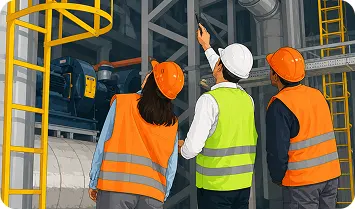
Safety instructions are only useful when workers understand what they mean and how to apply them on the job.
A written procedure might tell a construction worker to maintain a safe distance from a suspended load. But does the worker understand where to stand, how the load can swing, which areas must remain clear and what to do if conditions change?
This is where safety training videos can make a practical difference. They can turn written instructions into visible workplace scenarios, demonstrate the sequence of a procedure and help explain hazards that are difficult to show through text alone.
For businesses in the United Arab Emirates (UAE), effective safety training also needs to reflect the actual work environment, the workforce's language needs, the applicable regulations and the organisation's approved HSE procedures.
This guide explains how to identify training needs, select suitable video formats, prepare accurate content, manage production and assess whether workers have understood the safety message.
Quick Answer: What Are Safety Training Videos?
Safety training videos are visual learning resources that help workers recognise hazards, understand safety controls, follow approved procedures and respond appropriately to workplace situations.
Common types include safety induction videos, construction safety training, machinery operation demonstrations, HSE toolbox talks, emergency response training and incident reconstruction.
They can use live-action footage, 2D animation, 3D animation or a combination of formats. The right choice depends on the learning objective, the risk involved, the information that needs to be shown and the intended audience.
For UAE employers, these videos can support workplace training programmes, but they should be based on current requirements and approved procedures. A video alone does not establish regulatory compliance or replace practical instruction, supervision or competency assessments where these are necessary.
1. Why Do Workplaces Need Effective Safety Training Videos?
A workplace safety programme involves more than distributing a policy or asking employees to sign an induction form. Workers need to recognise hazards, understand the controls in place and know what actions are expected of them.
The UAE Government's guidance on health and safety at work explains employers' responsibilities for providing a safe working environment and complying with applicable occupational health and safety requirements.
Under Federal Decree-Law No. 33 of 2021 and its amendments, employers in the private sector have relevant occupational safety and health responsibilities, including providing appropriate training and preventive measures. The precise requirements depend on the applicable legislation, sector and circumstances.
Safety training videos can support these responsibilities by helping organisations communicate information in a structured and repeatable way.
Consider three everyday situations.
A new construction contractor arrives on site. They need to understand access restrictions, pedestrian routes, mandatory PPE, emergency arrangements and the process for reporting hazards. A site induction video can introduce these topics before work begins.
A maintenance technician needs to isolate equipment. A visual sequence can demonstrate the approved isolation procedure, identify the relevant components and show the required verification steps. The actual procedure must come from the organisation's authorised technical documentation.
A team needs to discuss a near miss. An animated reconstruction can illustrate the sequence of events, identify contributing factors and show where preventive controls should have been applied.
In each situation, the purpose is not simply to make information more attractive. It is to make the required action easier to understand.
Safety videos are particularly useful when an organisation needs to:
- Deliver consistent introductory training across multiple teams or locations.
- Explain unfamiliar equipment, procedures or workplace hazards.
- Demonstrate the difference between unsafe and approved practices.
- Support toolbox talks, refresher sessions and contractor inductions.
- Communicate technical information to a multilingual workforce.
- Reinforce classroom instruction and supervised practical training.
The effectiveness of a video still depends on its accuracy, relevance and how it is used within the wider training programme.
2. What Types of Safety Training Videos Should Organisations Produce?
The best starting point is to identify the task, the hazard and the action workers need to understand. This prevents organisations from producing generic content that looks professional but does not address a real training requirement.
Safety induction videos
Safety induction videos introduce new employees, contractors and visitors to the requirements of a workplace or project.
A construction site induction might include:
- Site access, registration and authorisation requirements.
- Mandatory PPE and site-specific restrictions.
- Pedestrian routes, vehicle movements and restricted zones.
- Emergency alarms, evacuation routes and assembly points.
- Hazard, incident and near-miss reporting.
- Welfare facilities and relevant site rules.
For UAE construction projects, induction content should reflect the actual site arrangements and the applicable requirements of the relevant authority, client and contractor.
Practical tip: Create a reusable induction structure for general company rules, then provide separate site-specific information where routes, emergency contacts, hazards or procedures differ.
Construction safety training videos
Construction safety training needs to address hazards that change as work progresses.
Topics may include working at height, scaffolding, ladder use, excavation, lifting operations, temporary electrical systems, vehicle movements, falling objects and material handling.
For example, a video about a lifting operation could show the designated exclusion zone, the responsibilities of the personnel involved, the approved communication method and the actions required if the lift cannot proceed safely.
The exact content must follow the approved lift plan, risk assessment and relevant site procedures. A generic animation should not be treated as an alternative to task-specific planning.
Industrial and machinery safety videos
Manufacturing facilities, workshops, warehouses and industrial plants often involve complex equipment and operating sequences.
Training may cover machine guarding, equipment isolation, lockout/tagout (LOTO), chemical handling, maintenance activities, conveyor systems and safe material movement.
For these subjects, the video should identify the relevant equipment, show the approved sequence and make critical controls easy to distinguish.
Where a procedure requires isolation, testing or verification, the video must not omit those steps merely to shorten the runtime.
HSE training and toolbox talk videos
Health, safety and environment (HSE) training videos can support broader awareness programmes, while toolbox talk videos usually address a specific task or hazard in a short, focused session.
Useful topics include manual handling, slips and trips, housekeeping, heat exposure, fire prevention, waste handling and working around moving equipment.
A toolbox talk video works best when it gives the supervisor a clear starting point for discussion.
For instance, after showing a manual-handling scenario, the supervisor can ask workers to identify the risk, explain which controls apply to their task and raise any concerns about the working conditions.
Emergency response videos
Emergency response training explains what workers should do when an alarm, fire, equipment failure, chemical release or other emergency occurs.
Depending on the workplace, a video may cover alarm recognition, evacuation, assembly points, reporting channels, shutdown responsibilities and the roles assigned to specific personnel.
Emergency procedures must match the organisation's approved emergency plan. Workers may also need drills, demonstrations and practical exercises to practise the required response.
Incident reconstruction videos
An incident reconstruction video shows how a workplace event unfolded and helps explain the contributing conditions.
Animation is particularly useful when the event cannot be filmed, the relevant equipment is inaccessible or recreating the scenario would be unsafe.
A reconstruction should distinguish verified facts from assumptions. It should focus on the sequence of events, failed or missing controls and preventive lessons rather than assigning blame without evidence.
3. How to Choose the Right Video Format
Not every safety topic requires animation. Choosing the format should begin with the question: What does the worker need to see to understand the task correctly?
| Training requirement | Suitable format | Why it can help |
|---|---|---|
| Site orientation and actual emergency exits | Live action or location-specific video | Shows real routes, facilities and surroundings |
| Basic hazard awareness | Live action, 2D animation or a hybrid | Makes unsafe and safe behaviours easy to compare |
| Internal machinery components | 3D animation | Reveals movement and parts that are difficult to see |
| Incident reconstruction | 2D or 3D animation | Recreates events without repeating a dangerous situation |
| Complex industrial processes | 3D animation or technical visuals | Explains relationships between equipment and process stages |
| PPE fitting and hands-on demonstrations | Live action with practical instruction | Shows actual equipment and how it fits or operates |
| Multilingual refresher training | Live action, animation or hybrid | Supports consistent visuals across language versions |
When is 2D animation useful?
2D animation is often suitable for simplified diagrams, hazard awareness, procedural sequences and scenarios where the main objective is to communicate an action clearly.
It can be effective when a worker needs to understand the relationship between a hazard and a control without requiring a detailed three-dimensional model.
Explore custom 2D animation services for training and business communication when a subject can be explained effectively through illustrated scenes, diagrams and focused visual storytelling.
When is 3D animation useful?
3D animation is particularly useful when depth, spatial relationships, equipment movement or internal components are essential to understanding the subject.
For example, a 3D sequence can show how a machine component moves, how materials travel through an industrial process or how the positioning of equipment affects a work area.
It can also help reconstruct complex incidents where the position and movement of people or machinery matter.
Learn more about 3D animation production for complex visual subjects if your training requirement involves equipment, industrial environments or detailed spatial relationships.
When should live-action footage be preferred?
Live action is often the better choice when workers need to recognise the actual site, equipment, emergency exits, PPE or personnel involved in a task.
A video showing the location of an assembly point, for example, is more useful when it reflects the real site rather than an illustrative environment.
Hybrid production can combine live footage with animation to explain an invisible hazard, highlight a restricted area or reveal a process that the camera cannot capture.
The objective is to choose the format that explains the subject accurately—not to use animation simply because it looks more sophisticated.
4. What UAE Workplace Safety Requirements Should Training Videos Reflect?
For organisations operating in the UAE, safety training content should be developed around the requirements that apply to the relevant business, work activity and location.
There is no single generic training video that automatically satisfies every UAE workplace safety obligation. Federal employment legislation, emirate-level requirements, sector-specific rules, client standards and approved company procedures may all be relevant.
Federal occupational health and safety responsibilities
The UAE's official workplace health and safety guidance refers to Federal Decree-Law No. 33 of 2021 regarding the Regulation of Employment Relationships and its amendments.
For applicable private-sector employers, occupational safety responsibilities include providing appropriate preventive measures, guidance and awareness, and training to help workers avoid occupational risks.
When developing a training video, employers should therefore identify the specific hazard or task being addressed, the applicable control measures and the training workers need to perform their duties safely.
The production team should work from approved source material rather than interpreting legislation independently.
Dubai construction safety requirements
Dubai has specific requirements for construction work. Decree No. 19 of 2025 concerning Safety in Construction Works in the Emirate of Dubai establishes the framework for a Code of Construction Safety Practice and applies to construction works within its stated scope.
In June 2026, Dubai Municipality issued Administrative Resolution No. 112 of 2026 approving the Safety Guide for Construction Works. Organisations should consult the latest official publications and applicable implementation requirements when preparing or updating construction safety material.
Refer to the official Dubai construction safety decree and Dubai Municipality's construction safety publications.
For a Dubai construction project, the practical process is to:
- Identify the applicable safety code, guide and project requirements.
- Obtain the current site rules, risk assessments, method statements and approved procedures.
- Identify the hazards and controls that workers must understand.
- Develop the script and storyboard around those requirements.
- Have the responsible HSE and technical personnel review the content.
- Recheck the video when the relevant requirements or procedures change.
The video supports communication of the approved requirements; it does not replace the project's safety management arrangements.
Abu Dhabi occupational safety and health requirements
Abu Dhabi has its own occupational safety and health framework. The relevant requirements and guidance should be checked for the sector and activity involved.
The Abu Dhabi Public Health Centre's official Codes of Practice include technical requirements covering subjects such as personal protective equipment, first aid, hazardous materials and occupational health and safety management during construction work.
The Abu Dhabi occupational safety and health management system information also provides sector-related guidance for building and construction activities.
For training video development, this means identifying the relevant code and version, confirming the controls that apply to the task and ensuring the visual sequence matches the approved procedure.
Organisations working across Dubai, Abu Dhabi and other emirates should not assume that every local process or requirement is identical.
Heat exposure and outdoor work
Heat exposure is an important consideration for UAE workplaces, particularly during outdoor work in hot weather.
Training should reflect the applicable heat-stress controls, company procedures and current official requirements. Depending on the activity, content may cover recognising symptoms of heat-related illness, hydration, rest arrangements, reporting concerns and the actions to take when a worker becomes unwell.
Employers should verify current requirements, including any applicable midday work restrictions and seasonal rules, through the relevant official authorities before approving the script.
The UAE Government's workplace health and safety guidance is a useful starting point for identifying the relevant official information.
Fire safety and emergency arrangements
Fire safety training should reflect the actual premises, approved emergency arrangements, relevant fire safety requirements and assigned responsibilities.
A video may explain alarm signals, evacuation behaviour, exit routes, assembly points and reporting procedures. However, a generic animation cannot identify the correct exit or assembly point for every building.
Before production, the client should supply the approved emergency plan and confirm that the proposed visuals match the workplace. Practical drills and other required training should continue as appropriate.
Important: This section is an educational overview, not a legal compliance checklist. HSE teams should confirm the latest applicable legislation, codes, permits, authority requirements and site procedures with their competent advisers and relevant authorities.
5. How to Develop a Safety Training Video That Workers Can Apply
A useful training video starts with the learning requirement and works backwards to the visuals.
The following process helps HSE teams, HR departments, training managers and production partners avoid common content problems.
Step 1: Define one clear learning outcome
Ask what the worker should know or be able to do after completing the training.
For example:
- Recognise the restricted area around a lifting operation.
- Identify when equipment must be isolated before maintenance.
- Follow the approved site evacuation procedure.
- Report a hazard through the correct channel.
A specific objective makes it easier to decide what information belongs in the video and what should be covered elsewhere.
Step 2: Gather the correct technical information
Before writing the script, collect the documents and information that establish the approved procedure.
Depending on the topic, these may include:
- Risk assessments and method statements.
- Standard operating procedures.
- Equipment manuals and manufacturer guidance.
- Site rules and emergency plans.
- Applicable codes, regulations and client requirements.
- Existing training materials and incident investigation findings.
Assign a qualified subject-matter expert to resolve conflicting information. A video producer should not have to guess which procedure is correct.
Step 3: Identify the audience and working conditions
Consider who will watch the video, their experience level, the languages they understand and where the training will take place.
A new contractor may need a different introduction from an experienced technician learning a revised procedure. A video intended for a site display may also need a different layout from one viewed on a mobile phone.
These details affect the language, pace, examples, visual complexity and delivery format.
Step 4: Write a clear, accurate script
A useful script connects the hazard to the required action.
For example, a training sequence about a moving conveyor might follow this structure:
- Situation: A worker approaches a conveyor during a task.
- Hazard: Moving components create a risk of entanglement.
- Required control: Explain the approved safeguards and restrictions relevant to the task.
- Correct action: Demonstrate the approved procedure, including any required isolation and verification steps.
- Knowledge check: Ask the worker to identify the action required before proceeding.
This is an illustrative structure, not a substitute for an approved conveyor safety procedure. The actual sequence must be verified by the relevant technical personnel.
Step 5: Build the storyboard
The storyboard translates each part of the script into a planned visual.
For each scene, identify what the worker sees, what the narration explains, which hazard or control is being highlighted and what action should be understood.
This is the point to decide whether live action, 2D animation, 3D animation or a hybrid approach will communicate the information most effectively.
A storyboard also allows HSE reviewers to identify missing steps before detailed production begins.
Step 6: Review and approve the visuals
Once the visuals are developed, check them against the source material.
Review PPE, equipment, labels, access restrictions, the sequence of actions, emergency arrangements and any other technical details relevant to the subject.
A scene can look realistic and still be wrong. Technical accuracy must take priority over visual appeal.
Step 7: Prepare the final training versions
The finished video may need subtitles, multiple voice-over languages, mobile-friendly versions, an LMS-ready file or a format suitable for workplace displays.
Confirm the delivery specifications before production is completed. Keep approved scripts, storyboards and source files organised so the video can be revised when procedures change.
6. How Can Safety Videos Help Multilingual Workforces in the UAE?
A safety instruction is only effective when the intended worker understands it.
UAE organisations may employ workers and contractors with different language backgrounds and levels of familiarity with technical terminology. Long sentences, unexplained abbreviations and culturally unfamiliar examples can make important instructions difficult to follow.
To improve comprehension, consider the following practices:
- Use plain language. Explain one action at a time and define technical terms when necessary.
- Show the action as well as describing it. A clear visual sequence can support the narration, particularly when workers are unfamiliar with the equipment or task.
- Prepare appropriate language versions. Depending on workforce needs, this may involve Arabic, English, Hindi, Urdu or other languages.
- Keep visuals consistent. When the same approved procedure is presented in different languages, consistent scene order and terminology help reduce confusion.
- Review translated content technically. A translation should preserve the meaning of the safety instruction, not merely reproduce the words.
- Check understanding. Use questions, supervisor discussions or practical demonstrations to determine whether workers have understood the procedure.
Subtitles can help in some situations, but they may not be sufficient when workers have limited reading proficiency or need to concentrate on detailed visuals. The format should suit the audience and the conditions in which the video will be viewed.
7. How Can HSE Teams Measure Whether a Safety Training Video Works?
Video completion is not the same as learning.
A worker may watch an entire video without understanding the critical control. HSE teams should therefore assess whether the training improves knowledge and supports correct behaviour.
Useful checks include:
- Knowledge checks: Ask questions about the hazards, controls and required actions.
- Practical demonstrations: Where appropriate, ask workers to demonstrate the procedure under suitable supervision.
- Supervisor observations: Check whether workers apply the relevant controls during actual work.
- Repeat assessments: Review understanding after refresher training or changes to the procedure.
- Training records: Record completion, assessment outcomes and any required follow-up according to the organisation's process.
- Content reviews: Check whether incidents, audit findings or procedural changes indicate that the training needs revision.
For example, if workers repeatedly misunderstand a particular isolation step, the solution may be to revise the explanation, improve the visual sequence or provide additional practical instruction.
Incident rates alone should not be used to judge the success of an individual video. Outcomes are affected by multiple factors, including supervision, equipment, work conditions and the wider safety management system.
The most useful evaluation connects the training objective to observable evidence of understanding and correct application.
8. How to Choose a Safety Training Video Production Company in the UAE
A production partner should be able to turn technical source material into understandable visual learning content without compromising the approved procedure.
Before selecting a provider, ask these questions:
- Can the team work with your HSE specialists? The production process should allow technical personnel to provide the correct documents, explain requirements and approve the content.
- Can the team explain complex subjects visually? Review examples relevant to your equipment, industry or training objective rather than assessing visual quality alone.
- Is there a structured approval process? Script and storyboard reviews help identify inaccuracies before they become expensive to correct.
- Can the provider recommend the appropriate format? Some topics suit live action, others benefit from 2D or 3D animation, and some require a combination.
- Can the content be localised? Confirm how narration, subtitles, translation and technical review will be managed for different workforce languages.
- Can the provider deliver the required files? Discuss aspect ratios, resolution, subtitles, LMS compatibility and other delivery specifications at the start.
- Can the video be updated? Procedures, equipment and site conditions can change. Confirm how revisions will be handled and whether editable project files can be supplied if required.
You can explore SparkAnimate's animation portfolio to review examples of its visual work and consider how different animation styles may suit your training requirement.
9. How SparkAnimate Can Support UAE Workplace Training
For UAE organisations that need to explain hazards, procedures or technical processes visually, SparkAnimate develops custom animation for workplace safety and other business communication needs.
The production approach can begin with the client's approved procedures and technical documentation, then move through script development, storyboarding, animation, review and final delivery. The objective is to make the subject easier to understand while preserving the information that workers need to learn.
Depending on the project, suitable formats may include 2D animation for clear procedural explanations, 3D animation for equipment and industrial processes, or a combination of animation and live-action footage.
Organisations can explore HSE animation and safety video production services for topics such as safety inductions, construction hazards, workplace procedures, incident reconstruction and HSE awareness.
For requirements beyond safety training, SparkAnimate's custom animation studio also supports visual communication for learning and development, product explanations, industrial processes and corporate communication.
The starting point is a clear brief: what workers need to understand, which approved procedures apply, who will watch the video and how the training will be delivered. Technical accuracy and client approval remain essential throughout production.
10. Safety Training Video Approval Checklist
Use this checklist before releasing a video to workers.
Content and technical accuracy
- The learning objective is clearly defined.
- The source documents are current and approved.
- The hazards and relevant controls are correctly explained.
- PPE, equipment and workplace conditions are represented accurately.
- The sequence of actions matches the approved procedure.
- Applicable UAE and local requirements have been checked.
- Emergency information matches the relevant workplace plan.
Learning and accessibility
- The language suits the intended workforce.
- Visuals make the required actions easy to identify.
- Translated versions have been reviewed for accuracy.
- The video includes a suitable knowledge check or follow-up activity where appropriate.
- Additional practical instruction or supervision has been identified where needed.
Production and maintenance
- HSE and technical reviewers have approved the content.
- The final file meets the required delivery specifications.
- Training records and any required assessments can be maintained.
- The owner responsible for future reviews has been identified.
- There is a process for updating the video when procedures or requirements change.
Approval should be based on the training objective and technical requirements—not simply whether the video appears finished.
Frequently Asked Questions About Safety Training Videos
It should include a clear learning objective, relevant workplace hazards, the applicable control measures, the correct procedure and understandable visuals or narration. The content should be reviewed by the responsible HSE or technical personnel before release.
Employers in the UAE have occupational health and safety obligations under applicable legislation. Training requirements depend on the workplace, sector, activity and relevant authority. A video may support a training programme, but employers should verify their specific obligations and must not assume that producing or showing a video alone satisfies them.
Depending on the project, it may cover site access, mandatory PPE, pedestrian and vehicle routes, restricted areas, hazard reporting, emergency arrangements and site-specific rules. The content should reflect current applicable requirements and the approved project procedures.
Neither is universally better. 2D animation often suits simplified explanations and procedural sequences, while 3D animation can be useful for machinery, spatial relationships and industrial processes. The right choice depends on what the worker needs to see and understand.
Yes. Animation can reconstruct a verified sequence of events and illustrate contributing factors or missing controls without recreating a dangerous incident. The reconstruction should be based on reliable evidence and reviewed by the relevant personnel.
Yes. Videos can use separate voice-over versions, subtitles or other language adaptations. The translated content should be reviewed to ensure that technical terms and safety instructions retain their intended meaning.
No. Videos can explain and reinforce information, but practical demonstrations, supervised practice, drills or competency assessments may still be necessary depending on the task and applicable requirements.
Review frequency depends on the subject, risk, applicable requirements and organisational procedures. Review the content whenever relevant equipment, site conditions, approved procedures or applicable requirements change, and at any other intervals required by the organisation or authority.
Conclusion: Turn Safety Instructions Into Clear, Practical Learning
Effective workplace safety training begins with accurate information and a clear understanding of what workers need to learn.
Safety training videos can help organisations explain hazards, demonstrate procedures and communicate consistent messages across teams. Their value depends on how well the content reflects the actual task, how clearly the message is delivered and whether workers can apply what they have learned.
For UAE employers, the process should also account for applicable federal legislation, emirate-level requirements, sector-specific codes and approved site procedures.
Live-action footage, 2D animation and 3D animation each have a role. The best format is the one that makes the safety message easier to understand without leaving out essential controls.
If your organisation needs to explain a workplace hazard, develop an induction resource or visualise a complex industrial procedure, explore SparkAnimate's HSE and safety video production services. For other training, product or corporate communication requirements, visit SparkAnimate's custom animation studio to explore the available animation approaches.