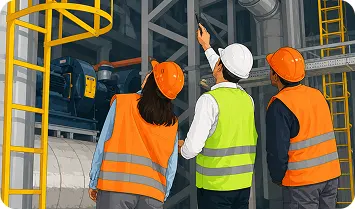
A written instruction can tell a worker to keep clear of moving machinery. A visual demonstration can show where the danger lies, what could go wrong and how to work safely.
That's where safety training videos can help.
From construction sites and manufacturing plants to oil and gas facilities, organisations need to explain safety procedures in ways that workers can understand and apply. The challenge is to make the information clear, relevant and easy to remember without leaving out important technical details.
In this guide, we'll look at the types of safety training videos organisations use, what makes them effective, how they're produced and when animation is a practical choice.
Quick Answer: What Are Safety Training Videos?
Safety training videos are visual learning materials that teach workers how to recognise workplace hazards, follow safety procedures and respond to specific situations. They can cover site inductions, PPE, emergency response, equipment operation, hazard identification and standard operating procedures (SOPs). Depending on the topic, a video may use live-action footage, 2D animation, 3D animation or a combination of formats. The right approach depends on the training objective, the workforce and the hazards being explained.
Why Are Safety Training Videos Important?
Safety training isn't just about telling people what they should and shouldn't do. Workers need to understand the risks they may face and know how to respond when a situation changes.
The US Occupational Safety and Health Administration (OSHA) identifies education and training as important parts of workplace safety programmes. Its guidance recommends teaching workers how to recognise hazards, understand controls, use required protective equipment and follow emergency procedures. It also stresses that training should be delivered in language and at a literacy level workers can understand.
You can read the guidance in OSHA's education and training recommendations.
A well-planned safety training video can help explain these requirements through specific workplace examples.
Imagine a new contractor arriving at a construction site. They need to know where they can walk, which areas are restricted, what PPE is required and how to respond if an alarm sounds. A clear induction video can introduce these points before the contractor starts work.
Or consider a machine operator who needs to follow a specific shutdown procedure. A step-by-step visual demonstration can help explain the correct sequence alongside written instructions and practical training.
Safety videos are particularly useful when organisations need to:
- Explain a procedure consistently across teams or locations.
- Introduce workers to site rules and common hazards.
- Show the difference between safe and unsafe actions.
- Support toolbox talks and refresher training.
- Explain technical processes that are difficult to describe in writing.
- Deliver training to workers who speak different languages.
A video isn't a replacement for every form of safety training. Practical demonstrations, supervision and competency checks may still be necessary. Its role is to make the relevant information easier to communicate.
What Types of Safety Training Videos Do Organisations Need?
The right video depends on the task, the risk and what the worker needs to learn. Here are some common examples.
1. Safety Induction Videos
Safety induction videos introduce new employees, contractors and visitors to the rules of a workplace or project.
They may cover:
- Site access and restricted areas.
- Personal protective equipment (PPE).
- Emergency exits and assembly points.
- Hazard reporting procedures.
- Site traffic and pedestrian routes.
- General workplace responsibilities.
For organisations with multiple sites, induction videos can help deliver a consistent introduction. Site-specific information should still be checked and updated when requirements change.
2. Construction Safety Training Videos
Construction sites change as projects progress. Workers may encounter different equipment, work areas and hazards from one stage to the next.
Construction safety videos can explain working at height, ladder safety, scaffolding, excavation, lifting operations, electrical hazards and the movement of heavy equipment.
For example, a working-at-height video could show how to identify an unsafe access point, explain the required protective measures and demonstrate the approved procedure.
The scenario should reflect the actual task and the relevant site requirements. A generic video may introduce a topic, but it shouldn't replace task-specific instructions.
3. Industrial and Machinery Safety Videos
Industrial workplaces often involve equipment and processes that are difficult to explain through written instructions alone.
Training videos can cover machine guarding, equipment isolation, lockout/tagout, chemical handling, maintenance activities and safe material movement.
Where a procedure involves several steps, the video should show them in the correct order. Any technical content should be reviewed by the relevant subject-matter experts before production is approved.
4. HSE Training and Toolbox Talk Videos
HSE training videos cover health, safety and environmental topics. Toolbox talk videos usually focus on one specific hazard or activity.
A short video about manual handling, for instance, could demonstrate an unsafe lifting technique, explain the risk and show the approved method.
These videos can support a discussion led by an HSE officer or supervisor. Workers should still have the opportunity to ask questions and clarify how the guidance applies to their own tasks.
5. Emergency Response Videos
During an emergency, workers need to know what action to take and whom to contact.
Emergency response videos can explain alarm signals, evacuation routes, reporting procedures, shutdown steps and designated responsibilities.
The content should match the organisation's approved emergency plan. Where appropriate, video training should be followed by drills or practical exercises so workers can practise the required actions.
6. Incident Reconstruction Videos
Sometimes, an incident or near miss is difficult or unsafe to recreate using live-action filming.
Animation can show the sequence of events, the conditions that contributed to the incident and the controls that should have been in place.
The aim is to help workers understand what happened and how similar risks should be managed—not to dramatise the event.
What Makes a Safety Training Video Effective?
A polished video isn't necessarily an effective training video. What matters is whether it explains the right information clearly and accurately.
Before production starts, consider these six points.
A clear objective: Decide what workers should understand or be able to do after watching the video. One focused objective is often easier to communicate than several unrelated messages.
A relevant scenario: Use examples that reflect the audience's actual tasks, equipment and work environment.
Visible hazards: Show the hazard and explain why it matters. Don't assume the viewer will notice a risk in a busy scene.
Correct procedures: Present the required steps in the right order. Avoid simplifying the content so much that an important safety control is missed.
Understandable language: Use direct sentences, familiar terms and clear narration. Add subtitles or other language versions when needed.
Technical review: Have the relevant HSE or technical personnel check the script and visuals. PPE, equipment, procedures and emergency information must be accurate.
One useful way to plan a training sequence is:
Identify the hazard → Explain the risk → Show the required control → Demonstrate the safe procedure.
This gives the video a clear purpose and helps keep the message focused.
When Should You Use Animation for Safety Training Videos?
Live-action footage is often a good choice when workers need to see their real workplace, equipment or colleagues performing a task. But some situations are difficult to film.
Animation can be useful when the training needs to show:
- The internal parts of machinery.
- A hazard that can't be seen directly.
- The movement of materials through a process.
- A dangerous scenario that shouldn't be recreated.
- An incident that needs to be reconstructed.
- A complex sequence involving several pieces of equipment.
- A process in an enclosed or inaccessible environment.
For example, filming the outside of an industrial machine may not explain how a component moves inside it. A 3D animation can reveal the internal mechanism and show how it relates to the procedure being taught.
Similarly, animation can reconstruct a lifting incident to explain positioning, equipment movement and contributing factors without repeating the dangerous event.
That doesn't mean animation is always the better choice. If the main objective is to demonstrate the correct fit of a particular harness or show a real emergency exit at a site, live-action footage or a practical demonstration may be more appropriate.
The format should serve the training objective.
HSE animation for workplace safety training
How Are Safety Training Videos Produced?
Professional production starts with the safety requirement, not the camera or animation software.
Step 1: Define the objective
Identify the hazard, task, audience and expected learning outcome.
For example, the objective might be to help workers understand the approved procedure for isolating a machine before maintenance.
Step 2: Gather the source material
The production team should review relevant SOPs, risk assessments, equipment information, site rules and approved safety procedures. The client should identify the people responsible for technical approval.
Step 3: Write the script
Turn the technical information into a clear sequence. Explain what the worker needs to recognise, what action is required and which mistakes must be avoided.
The language should be simple, but the safety requirements must remain accurate.
Step 4: Develop the storyboard
The storyboard maps the script to the visuals. It shows what appears on screen, what the narration explains and how the sequence moves from the problem to the correct procedure.
This is also the stage to identify scenes that may require technical diagrams, animation or live-action footage.
Step 5: Choose the production format
Depending on the topic, the video may use live action, 2D animation, 3D animation, motion graphics or a combination of these formats.
The choice should be based on what needs to be shown, the complexity of the subject and the available production requirements.
Step 6: Produce and review the video
The team creates the visuals, adds narration and sound, and edits the approved sequence. HSE or technical reviewers should then check the content for accuracy before final delivery.
Step 7: Prepare the final versions
The video may need different language versions, subtitles or formats for an LMS, training room, mobile device or workplace display.
A plan for future updates is also useful. If equipment or procedures change, the organisation should know how the relevant training content will be reviewed and revised.
How Can Safety Videos Support Multilingual Workforces?
A safety instruction only works if the worker understands it.
This matters for organisations with employees and contractors who speak different first languages. Technical terms, long sentences and unfamiliar expressions can make training harder to follow.
The International Labour Organization (ILO) recommends providing workers with safety information and training that is clear and understandable, taking language needs into account. Its guidance on workers and occupational safety and health also highlights communication needs for migrant workers.
OSHA similarly recommends delivering safety training in languages and at literacy levels workers can understand.
Organisations can support multilingual training by using:
- Separate voice-over versions for different languages.
- Subtitles where appropriate.
- Clear demonstrations of actions and procedures.
- Consistent visuals across translated versions.
- Simple, familiar language.
- Technical review of translated safety terminology.
In the UAE, the official government guidance on health and safety at work outlines employer responsibilities, including providing appropriate training to help workers avoid occupational risks.
Translation alone isn't enough. The final version should be reviewed to ensure that the instructions remain accurate and understandable.
How Should You Choose a Safety Video Production Company?
The right production partner should be able to turn technical information into clear visual communication. Visual quality matters, but it shouldn't be the only factor in your decision.
Before choosing a company, ask:
- Can they understand the subject? The team should be willing to work with your HSE personnel and technical experts.
- Can they explain complex procedures visually? Ask how they would approach your particular training objective.
- Do they use a clear approval process? Script and storyboard reviews can help identify problems before production progresses too far.
- Can they produce the required format? You may need live action, 2D animation, 3D animation or a hybrid approach.
- Can they support different languages? Check how narration, subtitles and translated versions will be handled.
- Can they deliver for your training platform? Confirm the required file formats, dimensions and delivery specifications.
- Can they show relevant work? Look for examples that demonstrate technical understanding, not just attractive visuals.
You can review SparkAnimate's animation portfolio to see examples of its visual work.
Safety Training Video Checklist for HSE Teams
Before approving a new video, use this simple checklist.
- The training objective is clear.
- The content reflects the approved procedure.
- Hazards and required controls are explained.
- Equipment and PPE are represented accurately.
- The sequence of actions is correct.
- The language suits the intended workforce.
- Subtitles or translated versions are provided where required.
- The HSE or technical team has reviewed the content.
- The final format suits the intended training platform.
- There is a process for updating the video when requirements change.
A video shouldn't be approved just because it looks finished. It should be checked against the training objective and the relevant safety requirements.
Frequently Asked Questions About Safety Training Videos
Safety training videos help workers understand workplace hazards, safety procedures, PPE requirements and emergency actions. Organisations use them for inductions, toolbox talks, equipment training, hazard awareness, refresher sessions and other workplace learning activities.
A safety training video should include a clear learning objective, accurate safety information, relevant examples, hazard identification and the correct procedure or control measures. The content should use language and visuals the intended workforce can understand.
A safety induction video usually introduces workers or contractors to a site, its rules and its basic safety requirements. An HSE training video can cover a broader range of health, safety and environmental subjects or explain a specific hazard, procedure or task in greater detail.
Yes. Animation can explain working at height, lifting operations, excavation hazards, equipment movement and incident scenarios. It can be particularly useful when a dangerous situation is difficult to film. The content should still reflect the actual work conditions and approved safety procedures.
Yes. Videos can be produced with different voice-over languages, subtitles or separate language versions. The final content should be checked for accurate terminology and clear instructions so workers can understand the safety message.
There is no single ideal duration. A short video may be enough to explain one hazard or procedure, while a full induction may need several sections. The video should be long enough to explain the subject properly without adding unrelated information.
No. Videos can support safety training, but they don't automatically replace hands-on demonstrations, supervised practice, competency assessments or other requirements. The training method should match the task, the risks and the applicable workplace requirements.
Conclusion: Make the Safety Message Clear
Workers need more than a list of rules. They need to understand the hazards around them and know what to do when it matters.
Safety training videos can help explain procedures, demonstrate safe behaviour and communicate consistent messages across teams. The most effective approach starts with accurate information, a clear objective and an honest understanding of what the audience needs to learn.
Sometimes, filming the real workplace is the right choice. In other cases, animation can show what a camera can't.
The important thing is to choose a format that makes the safety message clear without losing the details that matter.
If you're planning visual content for workplace hazards, safety induction or technical procedures, explore SparkAnimate's HSE animation service. If you'd like to discuss a specific training requirement, contact the SparkAnimate team.