Quick Answer
Safety training videos are visual training resources used to explain workplace hazards, safety procedures, equipment, emergency actions and safe working practices. Effective videos combine accurate safety information with clear visuals, relevant workplace scenarios and language workers can understand. They can support safety inductions, HSE training, toolbox talks, SOP training and hazard awareness across industries. Animation can be particularly useful when a hazard, internal process or high-risk scenario is difficult, dangerous or impractical to film.
What Are Safety Training Videos?
Safety training videos are visual learning materials designed to help workers understand workplace hazards, safety procedures, responsibilities and safe working practices.
Depending on the workplace and training objective, a safety training video may explain:
- Workplace hazards and how to recognise them
- Correct use of personal protective equipment (PPE)
- Emergency response and evacuation procedures
- Safe operation of equipment and machinery
- Standard operating procedures (SOPs)
- Hazard identification and risk controls
- Safety induction requirements
- Working-at-height precautions
- Confined-space procedures
- Chemical and hazardous-material handling
- Incident scenarios and lessons learned
- Site-specific rules and safe working practices
They can be used during employee onboarding, contractor induction, refresher training, toolbox sessions, e-learning programmes or other workplace safety initiatives.
The important point is that a safety training video should not simply communicate information. It should help the intended audience understand what the hazard is, what safe behaviour looks like, and what action is expected.
For example, telling a worker to maintain a safe distance from moving machinery is different from showing the machine operating, identifying the danger zone and demonstrating the correct procedure.
That distinction matters when designing workplace safety training videos.
Why Are Safety Training Videos Important for Workplace Safety?
Effective safety training gives workers the knowledge and skills needed to recognise hazards, understand controls and perform their work safely.
The U.S. Occupational Safety and Health Administration (OSHA) identifies education and training as important components of workplace safety programmes. Its guidance recommends training workers on workplace hazards, hazard identification and controls, emergency procedures, PPE and the responsibilities associated with their roles.
Recent research also provides evidence that safety training can positively affect training outcomes. A 2026 meta-analysis covering 157 independent studies found positive effects of safety training on trainee reactions, learning and transfer, with smaller effects on broader safety indicators. This distinction is important: training can contribute to workplace safety, but a training video by itself should not be presented as a guarantee of fewer incidents.
For organisations, this means the focus should be on training quality and relevance, not simply producing more videos.
A useful safety training video should answer questions such as:
- What is the hazard?
- Where could it occur?
- Who may be exposed?
- What causes the risk?
- What controls are required?
- What should the worker do?
- What should the worker avoid?
- What should happen during an emergency?
When the video is built around these questions, it becomes part of the safety communication process rather than just another piece of training content.
What Should an Effective Safety Training Video Include?
An effective safety training video starts with a clearly defined learning objective.
Before production begins, HSE and training teams should identify exactly what the worker needs to understand or demonstrate after watching the video.
1. A clear training objective
A video should have a specific purpose.
For example:
“After completing this training, workers should understand the correct procedure for entering a confined space and the hazards they must recognise before entry.”
That is more useful than a broad objective such as “teach confined-space safety.”
2. Realistic workplace situations
Workers should be able to connect the training to the environments and tasks they encounter.
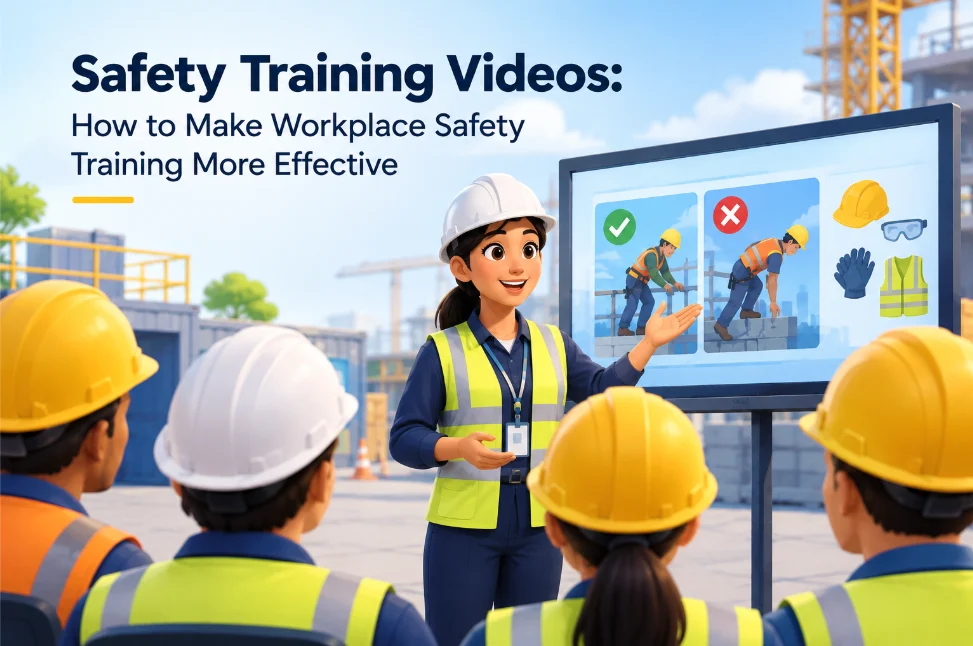
Construction safety training videos might show working at height, lifting operations, site access or PPE requirements.
Manufacturing training may focus on machinery, lockout/tagout procedures, moving equipment or hazardous materials.
3. Clear hazard identification
The video should make the hazard visible and explain why it matters.
Instead of simply showing a worker wearing PPE, the training can show the hazard first, explain the exposure and then demonstrate the appropriate control.
4. Correct procedures
Safety training should show the correct sequence of actions.
Where the procedure is technical, breaking it into clear steps can make the information easier to follow.
5. Appropriate language and terminology
Training must be understandable to the people receiving it.
OSHA guidance recommends providing training in language and vocabulary workers can understand. The International Labour Organization similarly emphasises clear, understandable safety information and training, including consideration of language needs.
This becomes especially important when organisations train multilingual workforces.
6. Accurate technical information
A visually impressive video is not useful if the procedure, equipment, PPE or hazard representation is inaccurate.
HSE teams and relevant technical personnel should review the content before final production and approval.
7. A clear takeaway
The viewer should know what action is expected after the training.
A strong ending might reinforce:
Recognise the hazard → follow the procedure → use the required controls → report concerns.
What Types of Safety Training Videos Do Organisations Use?
Different safety objectives require different types of training content.
Safety Induction Videos
Safety induction videos introduce new employees, contractors or visitors to workplace rules and hazards before they begin work.
They can cover:
- Site-specific hazards
- PPE requirements
- Emergency procedures
- Restricted areas
- Reporting procedures
- Site rules
- Evacuation routes
- Basic workplace expectations
For large organisations, a standardised induction video can also provide a consistent starting point for workers entering different sites or projects.
HSE Training Videos
HSE training videos cover broader health, safety and environmental subjects.
Topics may include:
- Hazard identification
- Risk assessment
- PPE
- Fire safety
- Environmental procedures
- Emergency response
- Safe work practices
- Incident reporting
Toolbox Talk Videos
Toolbox talks are generally short, focused safety discussions around a particular hazard, task or work activity.
A video format can support toolbox sessions by visually demonstrating the specific behaviour or procedure being discussed.
Hazard Identification Videos
These videos focus on helping workers recognise hazards before work begins.
For example, a training scenario might show a worksite containing several hazards and then identify the unsafe conditions one by one.
Emergency Response Videos
Emergency training can be difficult to communicate through written instructions alone.
A video can demonstrate:
- What triggers the emergency procedure
- Who should be notified
- Where workers should go
- What actions should be avoided
- How evacuation or response should proceed
SOP and Procedure Videos
Some procedures are easier to understand when workers can see the sequence rather than read a long document.
An SOP video can visually demonstrate the correct steps for operating equipment, completing a task or following a safety process.
Incident Reconstruction Videos
Animation can also be used to reconstruct incidents or near-miss scenarios where filming the original event is impossible or inappropriate.
The purpose should be to explain the sequence of events, contributing factors and safer procedures—not to sensationalise the incident.
When Should Organisations Use Animated Safety Training Videos?
Not every safety topic needs animation.
For some subjects, a live demonstration or on-site practical session may be more appropriate.
Animation becomes particularly useful when the information is difficult, dangerous or impossible to capture with conventional video.
Examples include:
- Internal machinery mechanisms
- Underground or enclosed processes
- Invisible hazards
- Chemical or gas movement
- Equipment operating zones
- Complex industrial processes
- Incident reconstruction
- Emergency scenarios
- Unsafe actions that should not be recreated in real life
- Procedures involving multiple moving components
For example, showing the internal movement of a machine through live-action footage may be difficult without disassembling the equipment. Animation can instead reveal the internal components and show how the mechanism works.
This makes animated safety training videos particularly useful when the learning objective depends on something that cannot easily be filmed.
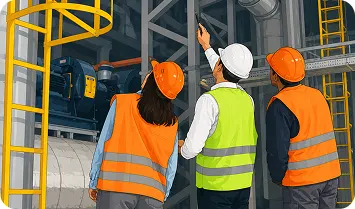
HSE animation for workplace safety training
How Can Animation Explain Complex Workplace Hazards?
One of the biggest advantages of animation for safety communication is its ability to control what the viewer sees.
A complex safety scenario can be broken into a simple visual sequence:
Hazard → Cause → Unsafe action → Potential consequence → Correct control → Safe procedure
Consider a construction-site working-at-height scenario.
A video could first establish the work environment, then identify the fall hazard, show the unsafe condition, explain the relevant control measures and finally demonstrate the correct working procedure.
The same approach can be used for:
- Confined-space entry
- Crane and lifting operations
- Electrical hazards
- Chemical exposure
- Machinery guarding
- Lockout/tagout
- Fire and emergency response
- Vehicle and pedestrian interaction
- PPE procedures
The objective is not to make safety training entertaining for its own sake.
The objective is to make the right information easier to see, understand and apply.
Research into multimedia occupational safety training has also found evidence that multimedia approaches can support learning transfer, although the research base and specific training designs vary. This is why animation should be treated as a training medium—not as a substitute for sound instructional design, practical training or competent supervision.
Which Industries Can Benefit From Safety Training Videos?
Safety training videos can be adapted to almost any environment where workers need to understand hazards and procedures.
Construction
Common applications include:
- Site induction
- Working at height
- PPE
- Excavation
- Lifting operations
- Electrical safety
- Equipment movement
- Emergency response
Oil & Gas
Training may cover:
- Process safety
- Permit-to-work procedures
- Hazardous areas
- Emergency response
- Chemical hazards
- Equipment safety
- Fire prevention
Manufacturing
Examples include:
- Machine operation
- Machine guarding
- Lockout/tagout
- Material handling
- Chemical safety
- Warehouse movement
- PPE
Energy and Utilities
Training can address:
- Electrical safety
- Equipment isolation
- Working at height
- Emergency procedures
- Maintenance activities
- High-risk operational tasks
Logistics and Warehousing
Possible subjects include:
- Forklift safety
- Loading and unloading
- Vehicle-pedestrian interaction
- Manual handling
- Warehouse hazards
- Emergency procedures
Healthcare
Training can cover:
- Infection control
- PPE
- Medical equipment
- Emergency procedures
- Workplace hazards
- Safe handling practices
The key is not the industry itself. The key is matching the training format and content to the actual hazards, tasks and workforce.
safety animation projects and workplace training examples
How Can Safety Training Videos Support Multilingual Workforces?
Safety information only helps when workers can understand and act on it.
The ILO recommends that safety information and training be clear and understandable, and specifically highlights language and communication considerations for migrant workers. OSHA guidance similarly recommends training in language and vocabulary workers can understand.
The UAE also places explicit emphasis on occupational health and safety. The UAE Government states that employers must provide appropriate training to workers to help them avoid occupational risks, while MoHRE guidance says workplace instructions may need to be provided in Arabic and other languages understood by workers.
For organisations operating with multilingual teams, a safety training video can therefore be designed with:
- Multiple voice-over languages
- Subtitles
- Clear visual demonstrations
- Minimal unnecessary text
- Consistent terminology
- Simple step-by-step sequences
- Language-specific versions for different worker groups
However, translation should not be treated as the entire solution.
A technically accurate translation can still be difficult to understand if the underlying training is complicated or poorly structured. Visual examples, clear narration and appropriate terminology should work together.
How Are Safety Training Videos Created?
A professional safety training video should begin with the training requirement—not with animation.
1. Define the training objective
Identify the hazard, task, audience and expected learning outcome.
2. Research the safety content
Review the relevant SOPs, risk assessments, regulations, equipment information and organisational procedures.
3. Develop the script
Convert the technical information into a clear training narrative without removing important safety requirements.
4. Create the storyboard
Plan how each part of the explanation will be visualised.
5. Produce the visuals
Depending on the subject, this may involve live-action footage, 2D animation, 3D animation, motion graphics or a combination of formats.
6. Add narration and language versions
Voice-over, subtitles and translated versions can be developed according to the workforce requirements.
7. Conduct technical and HSE review
The content should be reviewed for technical accuracy before final delivery.
8. Deliver for the intended training environment
The final video may be used through an LMS, website, presentation, mobile device, training room, workplace display or other approved training environment.
This process is important because safety content should not be treated like a conventional promotional video. Accuracy, clarity and training objectives need to guide production decisions.
How Should HSE Teams Evaluate a Safety Training Video?
Before approving a safety training video, HSE and L&D teams can use this checklist:
Content
- Does the video address a clearly defined safety objective?
- Is the information technically accurate?
- Does it reflect the organisation's actual procedures?
- Are relevant hazards clearly identified?
Visuals
- Are the workplace, equipment and PPE represented accurately?
- Does the visual sequence match the actual procedure?
- Are unsafe and safe behaviours clearly differentiated?
- Are complex processes explained visually where appropriate?
Workforce
- Can the intended audience understand the language?
- Is the terminology appropriate for their level of knowledge?
- Are subtitles or translated versions required?
- Does the video reflect the actual workforce and workplace environment?
Training use
- Can the video be used during induction or refresher training?
- Does it work as part of an LMS or e-learning programme if required?
- Does the video complement practical or hands-on training where necessary?
- Is there a clear way to evaluate whether the training objective has been achieved?
Review and maintenance
- Who approves the final content?
- What happens when the procedure changes?
- Does the video need to be updated when equipment, processes or regulations change?
A safety video should be treated as part of the organisation's broader training system, not as a standalone replacement for every other form of safety education.
Conclusion: Make Safety Information Easier to Understand
Safety training is most useful when workers can understand the hazards they face and the actions expected of them.
The right safety training video does more than present information. It connects a workplace situation to a hazard, explains the relevant control and demonstrates the correct procedure.
For some subjects, live-action training or hands-on instruction may be the right choice. For complex processes, hazardous scenarios, internal mechanisms or difficult-to-film situations, animation can provide another way to make the information visible.
The strongest approach is therefore not to ask whether animation is better than every other training format.
Instead, ask:
What does the worker need to understand, and what is the clearest way to show it?
For organisations looking to communicate workplace hazards, procedures and safety practices through purpose-built visual content, custom HSE animation for safety training can be one option to consider.
discuss your safety training video requirements
Suggested Tags
Frequently Asked Questions
Safety training videos are used to explain workplace hazards, procedures, emergency actions, PPE requirements and safe working practices. Common applications include employee induction, contractor training, HSE training, toolbox talks, SOP training, hazard awareness and refresher training.
A workplace safety training video should include a clear learning objective, accurate safety information, relevant workplace scenarios, hazard identification, appropriate controls and clear instructions. The language, vocabulary and visual presentation should also be appropriate for the workers receiving the training.
A safety induction video usually introduces workers or contractors to a particular workplace, site or organisation and its basic safety requirements. An HSE training video can address a wider range of health, safety and environmental topics, including specific hazards, procedures, equipment or regulatory requirements.
Animation can be useful when a hazard or process is difficult, dangerous or impossible to film. Examples include internal machinery, industrial processes, invisible hazards, incident reconstruction, complex procedures and emergency scenarios. The decision should be based on the learning objective and the nature of the information being communicated.
Yes. Safety training videos can be produced with different voice-over languages, subtitles or separate language versions. The important consideration is that workers receive information in language and vocabulary they can understand, supported by clear visuals and accurate safety terminology.
There is no universal ideal length for every safety training video. Duration should depend on the complexity of the subject, the audience and the training objective. A focused video covering one procedure or hazard may be short, while a broader induction programme may require several sections or separate modules. The priority should be clarity and completeness rather than reaching an arbitrary duration.